Why Perfect Food Costing Is Quietly Killing Your Kitchen
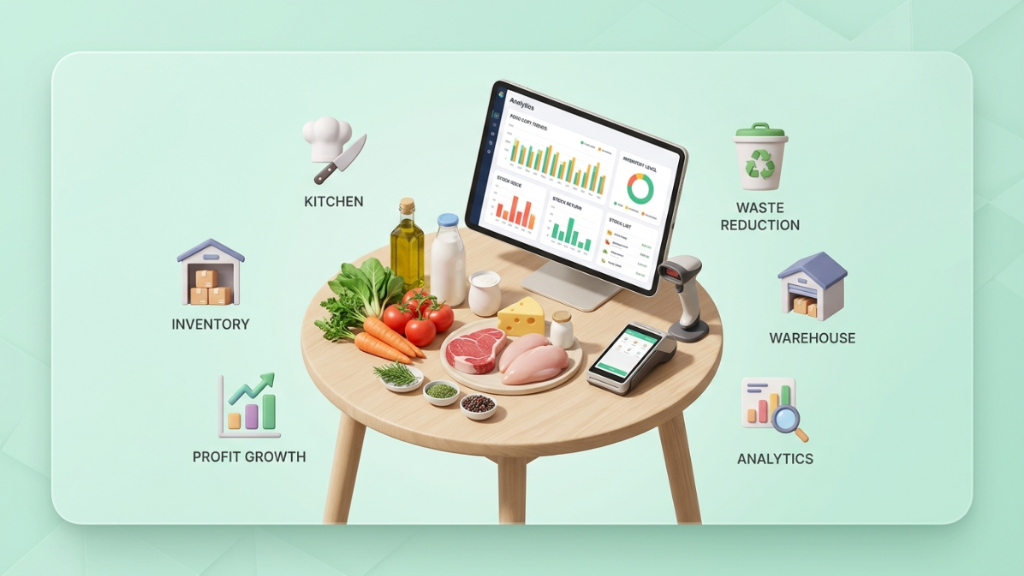
Most restaurant owners begin a new software implementation with one ambitious goal: “I want perfect, real-time, automated food costing.”
The intention is understandable. Owners want to know exactly how much every dish costs, where stock is being consumed, and whether the kitchen is operating efficiently. So they purchase advanced software, define recipes down to the last gram of spice, map every ingredient movement, and ask kitchen staff to record each stage of preparation.
In theory, it looks perfect. In practice, six months later, the system is often incomplete, inaccurate, or abandoned altogether.
The problem is not always the software. The problem is that the system demands a level of data entry and operational discipline that most working kitchens cannot maintain consistently. Perfect data may look impressive on a dashboard, but when collecting that data creates more work than value, the system begins to work against the restaurant.
The Reality of Staff Turnover
Hospitality businesses face frequent staff movement. Cooks, storekeepers, supervisors, and managers may change regularly. When a costing system depends heavily on one trained employee following a complicated process, the system becomes vulnerable the moment that employee leaves.
The next person must be trained again, and until that training is complete, entries are delayed, skipped, or entered incorrectly. Over time, small inconsistencies build up and the data becomes unreliable. Expecting every employee, across every shift, to track every ingredient down to the last gram is simply unrealistic for most restaurants.
A process that works only when the most disciplined employee is present is not a strong process. It is a fragile one.
Even the most advanced software still requires human judgment. There will always be wastage, returns, substitutions, over-portioning, staff meals, and operational adjustments. The goal should not be to remove human judgment completely — it should be to reduce unnecessary human effort while keeping meaningful controls in place.
Theoretical Food Cost vs. Operational Food Cost
Recipe costing remains important. It tells you what a dish should cost when the recipe, portion, yield, and purchase price are followed correctly. This is your theoretical food cost.
But restaurant operations are rarely that perfect. Actual food cost is affected by:
- Wastage and spoilage
- Incorrect portioning
- Staff meals
- Complimentary items
- Purchase price changes
- Store-to-kitchen transfers
- Kitchen stock remaining at the end of a period
- Unrecorded returns
- Pilferage or leakage
- Recipe substitutions
Theoretical costing is useful for menu pricing and margin planning, but it should not be confused with operational truth. A restaurant needs both: what should have been consumed, and what was actually issued or used. The problem begins when management expects recipe-level precision alone to explain every operational difference.
Factory-Style Operations vs. Working Kitchens
Granular ingredient tracking can work well in highly standardized operations. It may make sense when recipes rarely change, portions are mechanically controlled, central production is used, ingredients are pre-weighed, and production volumes justify the administrative effort. In these environments, the kitchen operates almost like a production facility.
But many independent restaurants, hotels, cafés, and flexible restaurant chains do not work this way. Recipes may change slightly according to ingredient quality, guest preference, chef judgment, seasonality, or availability. A chef may use a little more gravy in one order or substitute an ingredient in another. Preparation stock may remain in the kitchen for the next shift.
You are not running a laboratory. You are running a kitchen.
When the system demands that staff weigh, calculate, and record every routine movement, data-entry fatigue sets in. Eventually, employees stop entering actual information and start entering whatever is required to complete the process. The data may still look detailed, but it is no longer dependable.
The Practical Alternative: Issued Is Assumed to Be Consumed
A more practical approach is based on a simple operating principle:
Issued Is Assumed to Be Consumed
Once an ingredient leaves the main store, dry store, cold room, or walk-in cooler and is issued to the kitchen, it is treated as consumed for food-costing purposes. This does not mean ignoring control. It means shifting the focus from recording every routine action to recording meaningful exceptions. The more complete principle is:
Issued Is Assumed to Be Consumed — Unless Recorded as an Exception
This gives restaurant owners a practical and controllable system without placing an unrealistic burden on kitchen staff.
But What About Returns, Transfers, and Wastage?
This is the first question every operator asks — and the answer is what makes the model practical. None of it becomes a data-entry chore for the kitchen. Each case is handled where it naturally belongs.
Returns to store are simply a reverse entry on the store side. The original issue is reversed, so consumed cost drops automatically. The kitchen does nothing.
Transfers between kitchens route back through the store — returned to store, then issued to the other kitchen. No kitchen has the authority to push stock straight to another, so even when it happens physically, the entry stays clean and the audit trail is preserved.
Wastage or spoilage after issue stays inside food cost. Once stock is issued, whatever happens to it in that kitchen is a real cost of running that kitchen, so the system does not pretend it away. If the loss is significant, your variance and your physical stock check will surface it.
Closing kitchen stock is picked up during period-end physical verification, not entered shift by shift.
Complimentary and void sales sit slightly apart from the rest, because the food was genuinely consumed — just against a sale that earned nothing. This is left to the judgment of whoever does the final reconciliation. They have a complimentary and void sales report in hand, can express it as a percentage of total sales, and adjust the derived food cost accordingly — or leave it untouched. It is their call, because they are best placed to decide how much of that zero-revenue consumption should be absorbed into food cost.
The result is that the kitchen records almost nothing. The few real adjustments live in the store, the period-end count, and the final reconciliation — never in the kitchen.
Why This Model Works
Minimal operational effort. Cooks can focus on cooking instead of weighing and entering every ingredient movement. The store team records what was issued, and the kitchen only reports major exceptions — dramatically reducing the administrative burden.
Clear accountability. If the kitchen receives 10 kilograms of onions, the system treats 10 kilograms as kitchen consumption unless part of it is returned or otherwise accounted for. If consumption looks unusually high, management can investigate based on actual stock movement instead of relying only on theoretical recipe calculations.
More reliable data. Simple processes are easier to follow. When a system requires fewer entries, the entries that remain are more likely to be completed correctly. A simpler system with consistently entered data is more valuable than a highly detailed system filled with estimates, skipped entries, and backdated adjustments.
Better staff continuity. When employees leave, the next person does not need weeks of training to understand a complicated workflow. The principle is easy to explain: take stock through an issue, record major exceptions, and verify through physical stock checks. This makes the system far easier to sustain despite staff turnover.
Focus on high-value items. Not every ingredient deserves the same level of control. Tracking small quantities of salt, spices, or garnishes with extreme precision can consume more time than the value being protected. Management attention should be concentrated on high-value or high-risk items — meat, seafood, imported ingredients, cooking oil, cheese, alcohol, premium dry fruits, and high-cost packaged products. These may warrant tighter issue controls, daily reconciliation, or physical verification. The control level should be based on business risk, not on a desire to collect maximum data.
”Close Enough” Can Be More Useful Than “Perfect”
Restaurant owners do not need perfect data to make good decisions. They need dependable, timely, and actionable data. A practical food-costing system should help answer questions such as:
- Is food cost increasing?
- Which kitchen is consuming more than expected?
- Which items are showing unusual usage?
- Are purchase rates affecting menu margins?
- Is stock being issued without corresponding sales?
- Which menu items are becoming less profitable?
For many restaurants, decision-ready accuracy is far more valuable than theoretical perfection. The final small gap between operationally reliable data and mathematically perfect data may demand disproportionate manpower, supervision, and administrative cost — and that cost must also be considered. There is little benefit in saving a small percentage on food cost if achieving that saving requires another full-time employee, constant kitchen conflict, and hours of management review.
Physical Stock Verification Still Matters
The “Issued Is Assumed to Be Consumed” model does not eliminate physical stock-taking. Periodic physical stock helps management identify excess kitchen stock, unrecorded wastage, store shortages, incorrect issues, pilferage, data-entry errors, slow-moving ingredients, and expired stock.
The difference is that physical verification becomes a periodic control mechanism rather than a daily data-entry burden. The system gives you the operational picture; physical stock confirms and corrects it.
Use Recipe Costing as a Benchmark, Not a Burden
Recipe costing should still drive menu pricing, standard portion definition, expected gross margin, menu engineering, and the evaluation of purchase-price changes. But recipes should act as a benchmark — helping management compare expected consumption against actual store issues. They should not force cooks to become data-entry operators.
A good system might show:
| Measure | Amount |
|---|---|
| Expected consumption based on sales | ₹1,00,000 |
| Actual stock issued to kitchen | ₹1,08,000 |
| Recorded wastage and exceptions | ₹3,000 |
| Unexplained variance | ₹5,000 |
That variance is where management attention is needed. This is far more useful than asking staff to manually confirm every teaspoon, garnish, and preparation adjustment.
Stop Managing Data. Start Managing Profit.
A restaurant management system should provide a compass, not a microscope. You need to understand direction — whether food cost is improving or worsening, where major leaks are occurring, which ingredients need tighter control, and how menu profitability is changing. You do not need to turn your chefs into inventory clerks.
When you adopt the “Issued Is Assumed to Be Consumed” model — supported by exception reporting, recipe benchmarks, and periodic physical verification — food-cost control becomes practical. The system becomes easier to use, the data becomes more consistent, training becomes simpler, and management gets actionable information without creating friction inside the kitchen.
Do not let the pursuit of perfect data damage actual operations. Build a system that works for your kitchen, instead of forcing your kitchen to work for the system.
Ready to Simplify Food-Cost Control?
eresto is designed around the operational reality of restaurants. It combines store issues, kitchen accountability, recipe benchmarks, exception tracking, wastage control, and physical stock verification to deliver practical food-cost insights without burdening your team with endless data entry. And when your operation does justify it — central kitchens, pre-weighed production, or high-value items that need tight control — eresto scales up to granular tracking exactly where it is worth the effort.
Stop chasing perfect data. Start building a food-costing process your team can actually follow.
Book a free demo and see how eresto handles store issues, exception tracking, and food-cost reporting for your kitchen.